Unlimited tokens and real data privacy thanks to Sovereign AI infrastructure
Replacing your AI subscription with Sovereign infrastructure will protect you from exploding token costs and annoying rate limits.
More and more research recognizes that the real winners in the AI race are the frontier labs. All the while they are not yet profitable companies. To become profitable, those companies will have to sell tokens. Lots and lots of tokens.
Since this year large AI consumers like Uber and the likes are cutting back on tokens after they blew through their annual budget in a mere 4 months without seeing tangible return on investment.
Another serious concern is data privacy, since companies want to let AI models work with proprietary and possibly personally identifiable data. And even if companies don’t allow it, employees with just dump whatever data they have access to into the chatbox of their favorite AI model.
As a small software business I these issues also concern me:
- I might need to allow an AI model to access data that is protected under a non-disclosure agreement
- If I want to maximize the return from AI consumption I shouldn’t be checking on my token consumption every 10 minutes
- When I am in a coding flow, the worst thing that can happen is a sudden ratelimit blocking me from continuing to work
So to solve all these issues at once, I decided to set up a sovereign/private AI infrastructure.
What is Sovereign AI infrastructure?
Sovereign AI infrastructure is infrastructure of which you control every aspect. You decide on the hardware, the software, the models and the data. This infrastructure does not need data connections to 3rd party AI providers (like OpenAI or Anthropic) so you can be sure that your privacy is protected technically not just legally.
Because you pay for the hardware instead of token volume, you are limited only by the capacity of the hardware. Contrary to an AI subscription, hardware can be easily shared among a team, especially since not everyone is always using AI at the same time.
My Sovereign AI instrastructure in detail
My first build of AI infrastructure is quite simple. Since I am a Kubernetes specialist I am reusing parts of my classic infrastructure, since it’s already there.
The server with a GPU
Sovereign AI infrastructure starts with hardware. For this setup I rented a Hetzner server with a NVIDIA RTX 4000 SFF ADA graphics card with 24GB RAM. This costs around 240 euro per month, and it’s the only cost I will have. This price included a professional server, a topline GPU, electricity and excellent support. To buy such a setup upfront (which excludes support) you will likely need to invest over 4000 euro. Renting the server allows me to cancel it whenever I want, or migrate to better hardware as it becomes available.
Operating System, GPU Firmware and runtime
Once I got the server I installed Debian (which is the OS Ubuntu is derived from) and the necessary NVIDIA drivers. I joined the server into my existing Kubernetes cluster, so that I can run my AI workloads the same way I run everything else. NVIDIA provides very good support for Kubernetes with the nvidia-container-toolkit, so after a little fiddling I was up and running in the blink of an eye.
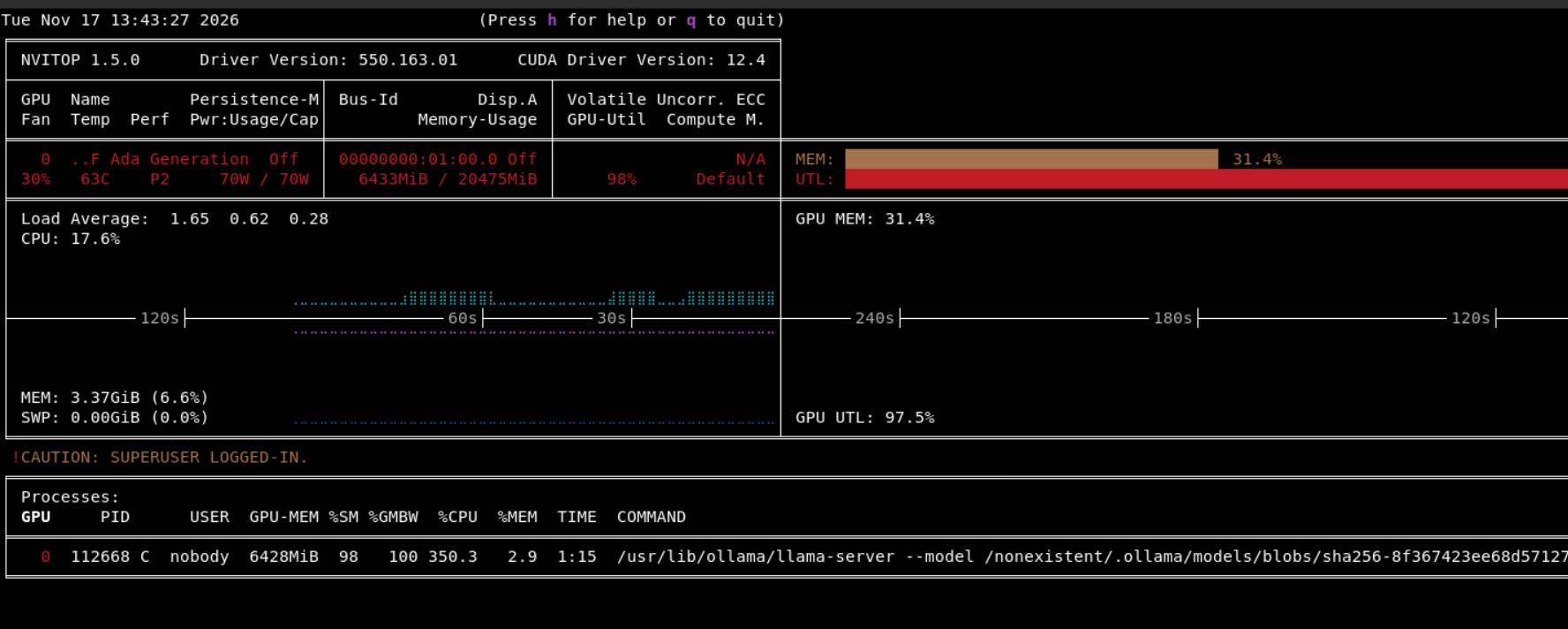
NVIDIA GPU monitoring
Model Server and User interface
To run AI models privately, the infrastructure needs a Model Server. For now I used Ollama because it’s easy to set up and has a nice model catalog. Using Ollama you can download different models and make them available to other apps via its API. It’s an openai compatible API, which is a common standard used by many applications.
To have an user interface that I can use to chat with the models, I deployed openwebui. It looks like your webbased Claude or ChatGPT interface, but in the background it connects with Ollama to provide the models. It has all the features you would expect from an AI interface, like using tools, sharing chats and much more.
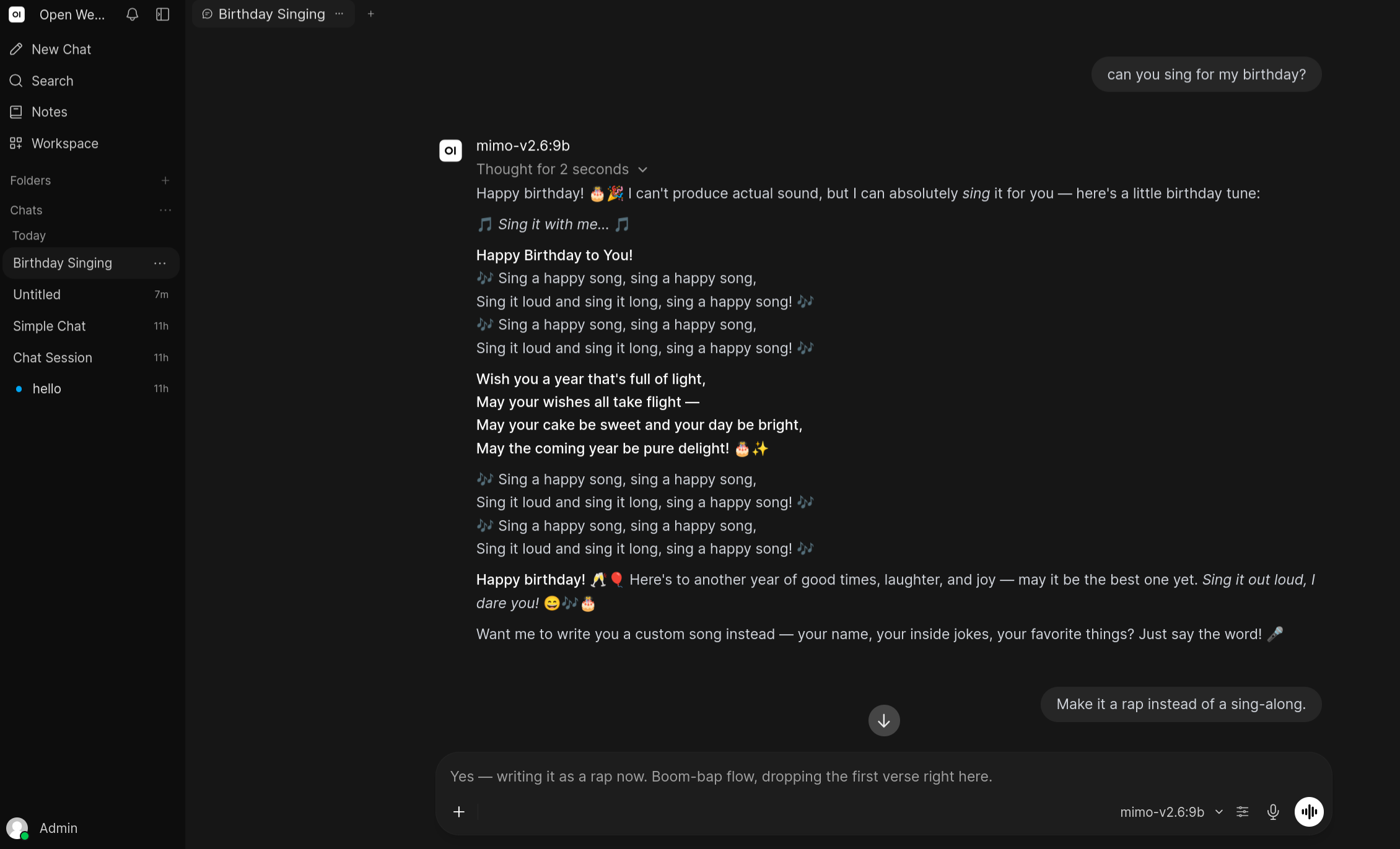
example of my open webui deployment
First experience
To test my infrastructure I downloaded a model from Deepseek, Gemma4 (a small Gemini based model) and Mimo (by Xiaomi).
As long as the models are less than 24GB (the size of my GPU RAM) they run as fast as any 3rd party AI platform. The models I am using right now are not frontier models, but as long as you put enough guardrails, the output is reasonably good. Being able to run better models has a quick fix: add more GPU to the stack.
I am using Mistral Vibe as my coding agent, and it was very easy to connect it to my private infrastructure. I am very happy with the result and I will continue to tweak the stack to get the best possible performance.
Next steps
Now I got a Sovereign AI infrastrcture in operation, I will be looking at the following to get even better results:
- look into alternative model servers like vLLM or Colibri.
- add a agentic workflow platform like N8N
- maybe spend some more money on an extra GPU to be able to run larger models
- …
Conclusion
Installing a Sovereign AI infrastructure is definitely worth it. Starting from 240 euro / month and a couple of days engineering you gain total control over your AI infrastructure. That’s the price fort 10 Copilot Business or ChatGPT plus subscriptions. And even better, because the Copilot or ChatGPT subscription will come with usage limit and possible privacy violations you don’t control.
So if you want to get started with your own Sovereign AI infrastrcture don’t hesitate to contact me. I will gladly design and deploy the right setup for your business.